How to Secure GeoServer APIs Using JWT Authentication and AWS
 By Renjith Kumar
| May 22, 2026
By Renjith Kumar
| May 22, 2026

Introduction
Organizations that handle geospatial data must prioritize security because exposed mapping services can quickly become vulnerable to cyber threats. Therefore, businesses increasingly look for reliable ways to secure GeoServer APIs while maintaining scalability and performance. Moreover, cloud-native infrastructure now makes it easier to secure GeoServer APIs using authentication layers, private networking, and centralized access control.
GeoServer is widely used for publishing geospatial data through WMS, WFS, and WCS services. However, exposing GeoServer directly to the internet can create major security risks. As a result, unauthorized users may gain access to sensitive spatial datasets, API endpoints, or internal services.
To solve this challenge, we implemented a secure AWS-based architecture using JWT authentication and private cloud networking.
Why Securing GeoServer Matters
Although GeoServer is powerful and flexible, it is not designed to operate securely as a publicly exposed service without additional protection layers.
Without proper security, organizations may face:
- Unauthorized access to WMS/WFS endpoints
- Exposure of confidential geospatial data
- Lack of centralized authentication
- Difficulty monitoring API activity
- Increased infrastructure security complexity
Consequently, businesses need a scalable architecture that validates every request before it reaches GeoServer.
High-Level AWS Architecture
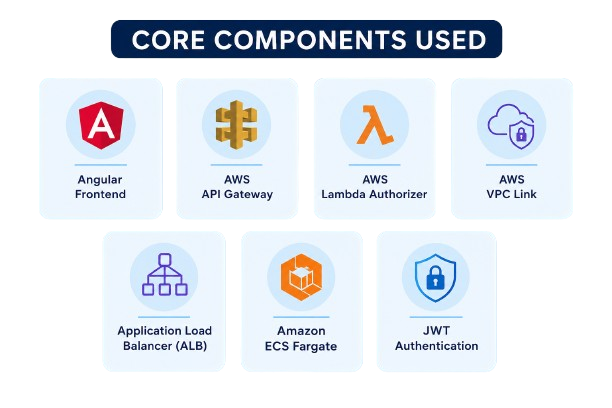
Our architecture ensures that GeoServer remains completely private while all incoming traffic passes through secure AWS services.
Furthermore, this layered approach improves both scalability and security.
Architecture Flow
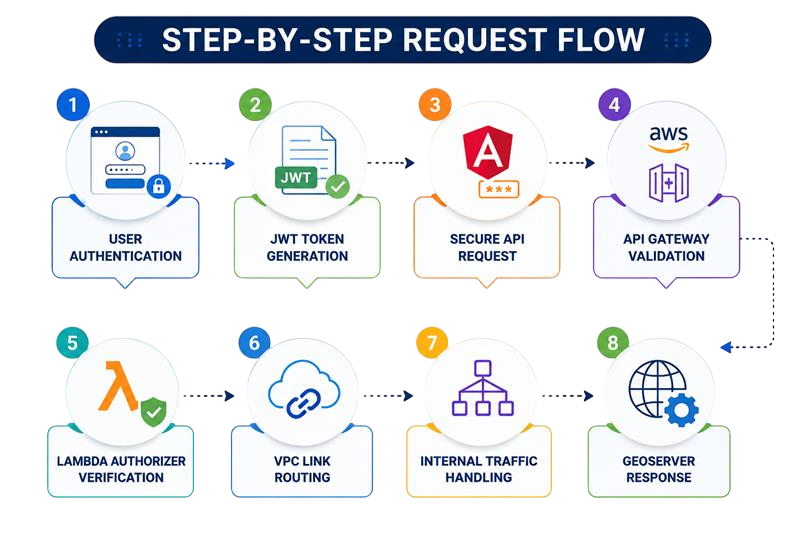
The request flow follows a secure validation chain before GeoServer processes any request.
JWT Authentication Layer
JWT authentication serves as the core security mechanism in this architecture.
Key Security Advantages
- Every request carries a signed token
- Tokens include user identity and permissions
- Unauthorized traffic gets blocked instantly
- Authentication remains centralized
- GeoServer never handles unauthenticated requests
As a result, the system maintains strong access control while reducing backend security risks.
Private Network Design
GeoServer runs securely inside a private VPC using Amazon ECS Fargate.
Network Security Features
- No public IP exposure
- Internal-only Application Load Balancer access
- Secure VPC Link integration
- Network-level isolation
- Restricted external connectivity
Therefore, GeoServer remains inaccessible from the public internet.
Security & Access Control
Security is enforced at multiple independent layers to reduce vulnerabilities.
Multi-Layer Security Approach
- JWT-based authentication
- Centralized authorization through API Gateway
- Role-based access management
- Network isolation via VPC
- Controlled routing through ALB
Even if attackers attempt direct access, the infrastructure blocks unauthorized requests before they reach the backend.
Benefits of This Architecture
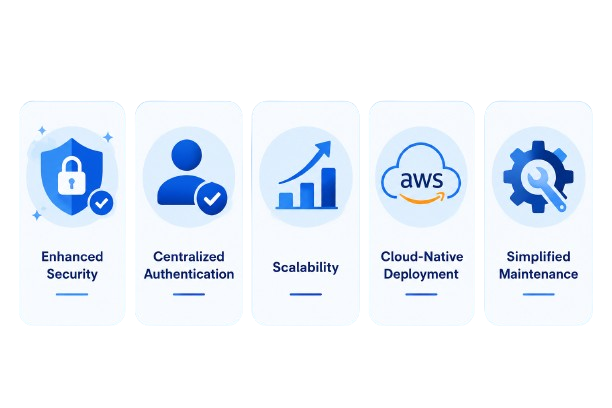
This AWS-native setup provides several operational and security advantages.
Securing geospatial services requires more than simply deploying GeoServer behind a firewall. Instead, organizations must implement strong authentication, controlled routing, and private networking.
By combining JWT authentication with AWS services such as API Gateway, Lambda Authorizer, VPC Link, ALB, and ECS Fargate, businesses can build a highly secure and scalable geospatial infrastructure.
Ultimately, this architecture protects sensitive data, improves operational efficiency, and delivers secure API access without exposing GeoServer directly to the internet.
Author
Related articles


Contact us

Leave us basic information about a project and we will get back to you with answer
Need instant answers?
Our AI assistant is available 24/7 to answer questions on pricing, timelines, and project scope.
Click Here