AI Sovereignty at Davos 2026: How India Is Building a Full-Stack AI Future
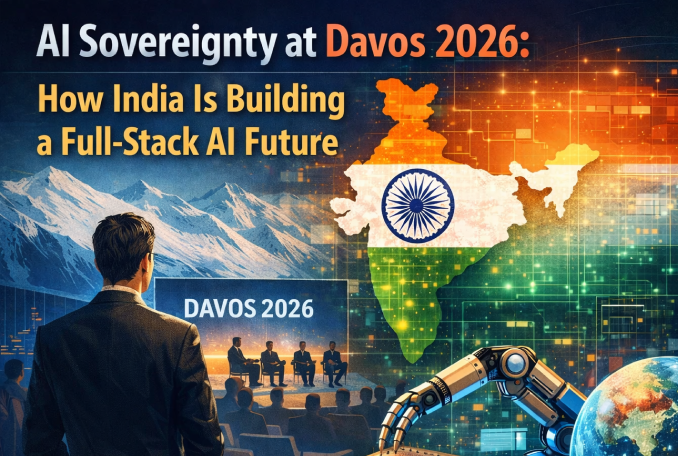
At the World Economic Forum (WEF) 2026 in Davos, Switzerland, global leaders focused on one defining issue: Artificial Intelligence as a driver of economic power, security, and sovereignty. Under the theme “A Spirit of Dialogue,” India presented a clear and confident vision, AI leadership through self-reliance, scale, and responsible innovation.
Rather than positioning AI as a standalone technology, India framed it as a strategic national capability, spanning chips, compute, models, infrastructure, energy, and governance.
AI as a Geopolitical and Economic Imperative
AI is no longer just about innovation. It is now central to:
- Economic competitiveness
- Supply chain resilience
- National security
- Global influence
At Davos 2026, India emphasized a shift from AI consumption to AI co-creation, aligning technology growth with long-term sovereignty and global trust.
Building a Complete Semiconductor Ecosystem
A strong AI future starts with chip independence.
India is developing a full semiconductor value chain, including:
- Chip design
- Fabrication and manufacturing
- Advanced packaging and testing
- Materials and equipment ecosystems
Key highlights:
- Commercial semiconductor production begins in 2026
- Indian startups are designing advanced-node chips, including next-generation architectures
- India is emerging as a reliable alternative in global semiconductor supply chains
This approach reduces dependency while strengthening global diversification.
Scaling AI Infrastructure for the Future
AI at scale requires massive computational capacity.
India’s AI infrastructure roadmap includes:
- Gigawatt-scale data centers
- A national GPU compute pool
- Distributed cloud and edge infrastructure
- AI-ready digital public infrastructure
This foundation enables:
- Large-scale model training
- Real-time AI deployment
- Enterprise and public-sector AI use cases
Model Strategy Focused on ROI and Practical Deployment
Instead of relying on a few extremely large AI models, India is developing a bouquet of sovereign AI models in the 50–120 billion parameter range, designed to run efficiently on smaller GPU clusters.
In real-world deployment, it has become clear that around 95% of practical AI use cases can be handled by models in the 20–50 billion parameter range. These models are faster to deploy, cheaper to run, and easier to scale.
By focusing on right-sized models, the strategy prioritizes productivity, efficiency, and economic returns, ensuring that AI delivers measurable value across sectors.
Sovereign Capability and Strategic Resilience
AI sovereignty is not defined by model size alone. Very large models are costly and do not automatically create geopolitical or economic advantage.
A diversified portfolio of domestic AI models allows India to meet most national and enterprise needs without relying heavily on external providers. This reduces strategic risk and ensures continuity even if access to foreign AI platforms is restricted or disrupted.
This approach strengthens long-term autonomy while keeping AI economically sustainable.
India’s 5-Layer AI Sovereignty Strategy
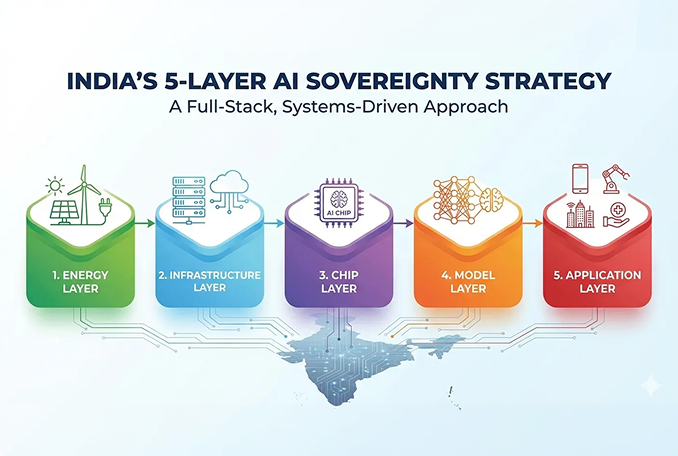
India’s AI roadmap follows a full-stack, systems-driven approach, covering every critical layer:
1. Energy Layer
- Clean energy integration
- Next-generation nuclear solutions
- Sustainable power for AI workloads
2. Infrastructure Layer
- National-scale compute and cloud capacity
- Secure, sovereign AI deployment
3. Chip Layer
- Indigenous chip design and development
- AI-specific processors and accelerators
- Long-term roadmap for advanced process nodes
4. Model Layer
- Cost-efficient domestic AI models
- Optimized for local and global use cases
- Reduced dependency on external systems
5. Application Layer
- AI solutions for agriculture, healthcare, governance, and industry
- Focus on real-world impact and productivity
This layered strategy ensures scalability, security, and long-term autonomy.
India’s AI Credentials: Backed by Global Benchmarks
“India ranks third globally in Stanford University’s AI Vibrancy Index, according to the 2025 Global AI Vibrancy Tool.”
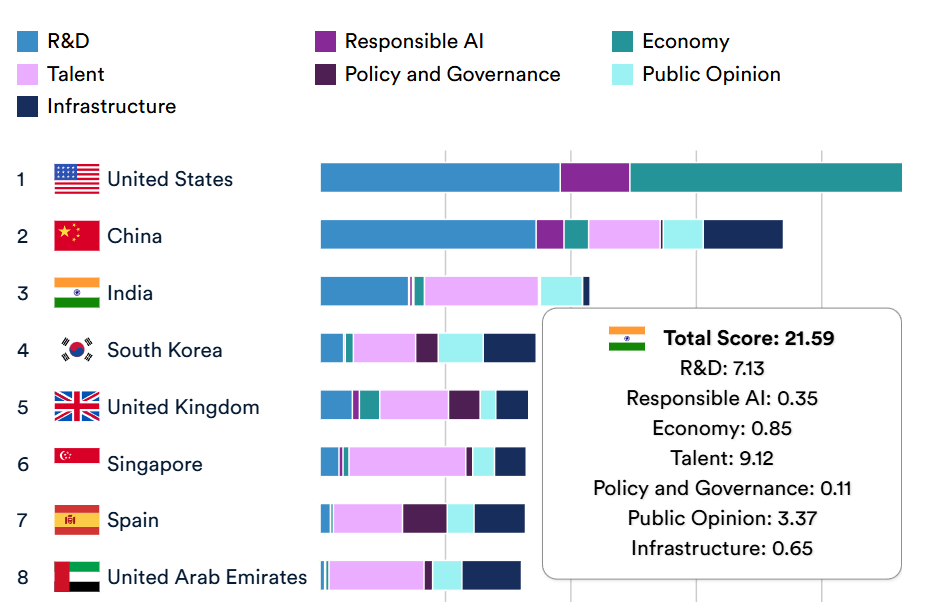
These metrics reflect:
- Strong digital infrastructure
- Large, skilled AI workforce
- Rapid real-world AI deployment
They challenge outdated classifications and reaffirm India’s position as a core global AI contributor, not a peripheral player.
Diffusion, Skills, and Workforce Transformation
Beyond infrastructure and models, the priority is AI diffusion at scale.
A national AI skills initiative is underway to train millions of people, enabling a smooth transition from traditional IT services to AI-enabled solutions. This strengthens the workforce while supporting both domestic and global enterprise needs.
By combining affordable compute access with large-scale skill development, AI adoption is accelerated across the economy.
The AI Impact Summit: Three Strategic Goals
Building on Davos momentum, India will host the AI Impact Summit 2026 in New Delhi, centered on three clear objectives:
1. Economic Impact Through AI Efficiency
- Boost productivity across sectors
- Optimize public and enterprise systems
- Deliver measurable economic value
2. AI Accessibility for the Global South
- Lower cost barriers to AI adoption
- Enable local-language and regional models
- Promote inclusive and affordable AI innovation
3. AI Safety, Trust, and Governance
- Establish practical regulatory frameworks
- Promote ethical and responsible AI use
- Balance innovation with accountability
The summit positions AI as a tool for people-centric growth, planetary sustainability, and long-term progress.
India as a Stable AI and Economic Growth Engine
In a volatile global environment, India stands out for:
- Policy continuity
- Democratic stability
- Strong digital public infrastructure
- Sustained economic growth projections
AI plays a central role in this trajectory supporting innovation while reinforcing resilience and trust.
AI Leadership Through Sovereignty and Scale
Davos 2026 made one message clear:
The future of AI belongs to nations and enterprises that control the full stack – chips, compute, models, energy, and governance.
Moreover, India’s approach clearly demonstrates how AI sovereignty, inclusivity, and scale can coexist. By strategically aligning technology with economic impact and global responsibility, India is not only shaping its own AI future but also actively influencing the broader direction of the global AI ecosystem.
Related articles



Contact us

Leave us basic information about a project and we will get back to you with answer